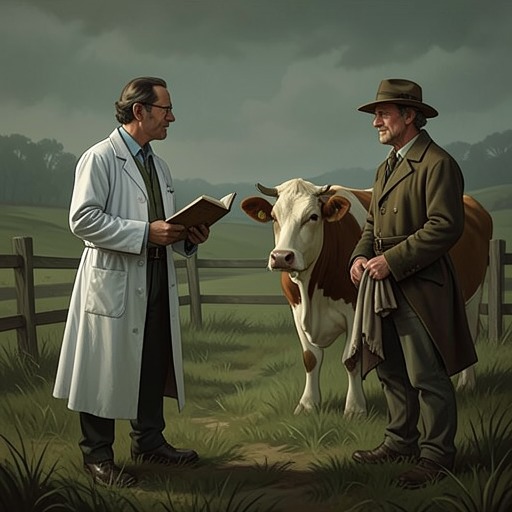
“There’s a very fine dividing line between looking a real smart vet and an immortal fool”
All Creatures Great and Small“There’s a very fine dividing line between looking a real smart vet and an immortal fool” is Siegfried Farnon’s compact account of veterinary uncertainty. Spoken to reassure James Herriot after a cow unexpectedly rose, the line reaches beyond that one embarrassment: across the cases gathered here, clinical judgment depends on incomplete signs, careful examination, and outcomes that can make a sound decision appear mistaken—or an uncertain one appear prescient.
Meaning and Occasion
Siegfried offers the phrase after James believes he has mishandled the treatment of a cow that had remained down. He explains that the pelvic ligaments may take days to tighten after calving, and suggests that the animal may have been about to rise when the farmer laid a sheepskin on her back. The cow could just as readily have stood after one of James’s injections, in which case James would have received the credit. Siegfried’s point is not that treatment and judgment do not matter, but that the visible result does not always reveal what caused it.
His counsel is deliberately balanced: the same uncertain interval separates the appearance of a capable veterinarian from that of a fool. He tells James that this happens to all of them and urges him to forget the episode. Forgetting proves difficult. The cow becomes a local celebrity, and the farmer repeatedly points her out to visitors as the animal James said would never get up again. A private lesson in professional fallibility is thus transformed into a public anecdote that preserves the most damaging version of the mistake.
Examination Before Certainty
Other cases show the practical work behind that uncertainty. At Lord Hulton’s estate, James encounters a hunter staggering around its box, drenched in sweat and in continuous pain. He initially says that the condition could indicate a twisted bowel, explicitly withholding certainty until he has examined the horse. A rectal examination then reveals displacement of the small intestine and an abnormal, tense mass. The sequence moves from alarming visible symptoms, through a provisional diagnosis, to evidence obtained by touch; expertise is shown as a process rather than an instant declaration.
The same discipline appears in James’s examination of the cow Strawberry. She is still eating, has a normal temperature and clear lungs, but gulps slightly when swallowing, and a faint snoring sound can be heard near her head. James considers inflammation as well as the possibility of an abscess behind the throat. Over the next ten days he watches the abscess develop while Strawberry eats less, loses weight, and gives less milk. He knows rupture is what may bring relief, but the injections he gives are largely irrelevant and the abscess is slow to burst. Here, attentive observation does not produce control over the course of the illness.
Signs, Risks, and Reversals
The evidence also includes cases in which a small clue points toward a serious problem. In another examination, an old dog’s distended abdomen, painful breathing, and inward expression lead James to recognize pronounced ascites; even the dog’s brief response when his master speaks quickly fades. The signs must be read together, rather than reduced to a single reassuring gesture.
At Mr. Alderson’s farm, James’s embarrassment after Mrs. Hall’s bath salts release a strong scent under his clothing is displaced by the examination itself. He finds the vagina nearly closed, with the calf’s feet and head beyond the narrow opening, and recognizes a uterine torsion. The live calf has no clear way out. The abrupt change from social discomfort to a grave diagnosis makes the limits of appearance especially sharp: the scene’s embarrassment is real, but the animal’s condition immediately takes precedence.
Professional Judgment and Retrospect
Taken together, these episodes distinguish uncertainty from carelessness. James does not simply guess at the horse’s condition, Strawberry’s throat problem, or the twisted calf bed; he observes, examines, revises, and acknowledges what he cannot yet know. Yet neither experience nor method guarantees that an outcome will vindicate the practitioner. The cow’s recovery gives the farmer a story of apparent failure, while Siegfried sees a reminder that the timing of recovery may not prove what brought it about.
The phrase endures because it describes both the work and its public interpretation. Veterinary decisions are made amid pain, incomplete information, and changing signs; afterward, other people may compress that uncertainty into a verdict. Siegfried’s reassurance does not erase the farmer’s repeated boast, but it offers James a more generous measure of professional competence: not infallibility, but judgment exercised honestly when certainty is unavailable.